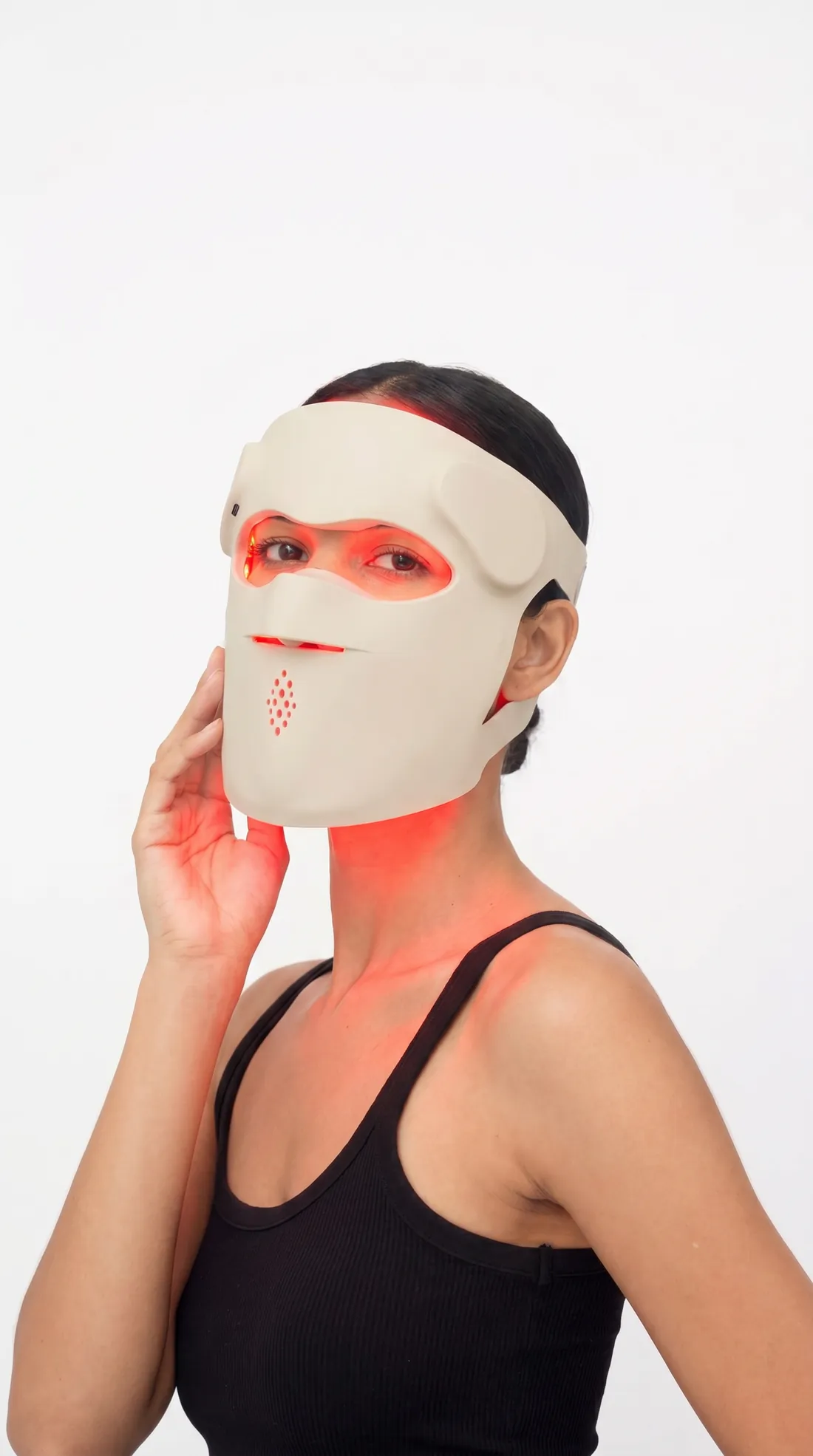
Wavelengths
Which colours of light the mask emits, in nanometres. Red and near-infrared carry the strongest evidence; other colours vary.
LED face masks · nine devices
Side by side on six published specifications: wavelengths, diode count, irradiance, session length, regulatory status and fit. Every figure in the table is one the manufacturer publishes itself, and nothing is filled in where a brand stays silent.
Key facts
What the columns mean
Silicone or rigid shell, eye cut-outs, a ten-minute timer — most of the category converges. Session length and fit are worth a glance, but these four are where the devices genuinely diverge, and where a spec sheet can mislead you if you read it the wrong way.
Which colours of light the mask emits, in nanometres. Red and near-infrared carry the strongest evidence; other colours vary.
How many diodes, which drives how evenly light reaches the face. A coverage figure, not an efficacy one.
Output in mW/cm². Multiplied by session length it gives dose — the figure that would let you compare masks properly. Most brands omit it.
FDA clearance, CE marking and safety testing. A signal about manufacturing and safety — not proof of results.
Spectrum coverage
Every emitted wavelength each manufacturer publishes, plotted from 400 nm to 1100 nm. The shaded bands mark the two ranges with the strongest published evidence for skin.
Side by side
Dr. Renú leads on the published specs-and-value balance and is pinned first; the other eight masks remain alphabetical. Where a manufacturer publishes no figure the cell says so — an empty column is itself worth knowing about.
| Brand & model | Wavelengths | LEDs | Published irradiance | Dose per session | Session | Regulatory | Fit & power | Price (EU) |
|---|---|---|---|---|---|---|---|---|
| Dr. Renú SpectraLift™ Advanced | 465 nm530 nm630–660 nm850 nm | 280 | 26.9–50.0 mW/cm² by mode · red/NIR 38.4–42.6 | up to 30 J/cm² | ~10 min 9 selectable modes |
FDA 510(k) K253712, Class II · CE · ISO 13485 · IEC 60601 · IEC 62471 | Flexible silicone, 300 g Rechargeable 2000 mAh USB-C |
€389.00 |
| CurrentBody Skin LED Mask Series 2 | 633 nm830 nm1072 nm | 236 | ~30 mW/cm² | ~18 J/cm² | 10 min Single automatic programme |
FDA cleared · CE | Flexible silicone Rechargeable clip-on controller |
€449.99 |
| Dr. Dennis Gross DRx SpectraLite FaceWare Pro | 415 nm630 nm | 162 (100 red · 60 blue) | Not published | — | 3 min Red, blue or both |
FDA cleared 510(k) · CE | Rigid hard shell Corded controller |
No EU storefront $455 US list |
| Nanoleaf LED Light Therapy Face Mask | 640 nm850 nm | 432 | Not published | — | 10–20 min 7 modes |
FDA cleared · CE | Flexible Rechargeable |
€149.99 |
| Omnilux Contour Face | 633 nm830 nm | 132 | ~30 mW/cm² | ~18 J/cm² | 10 min Single programme, 3–5×/week |
FDA cleared · CE · TGA (Australia) | Flexible silicone Rechargeable controller |
€453.75 |
| Shark CryoGlow (FW312) | 415 nm630 nm830 nm | 160+ (multi-zone) | Not published | — | 8 min 3 targeted programmes + under-eye cooling |
FDA cleared · CE/UKCA | Rigid, multi-zone Corded USB-C (cooling needs power) |
€379.99 |
| Silk’n LED Face Mask 100 | 463 nm592 nm633 nm | 100 | Not published | — | ~10 min 4 colours |
CE marked cosmetic device — no FDA clearance for this model | Semi-rigid Rechargeable, ~130 min runtime |
€160.00 |
| The Light Salon Boost Advanced | 633 nm830 nm | 112 (56 × 633 nm · 56 × 830 nm) | ~30 mW/cm² · ~18 J/cm² per session | ~18 J/cm² | 10 min Single programme, 3–5×/week |
FDA 510(k) K191629 · CE | Flexible silicone Rechargeable battery pack |
€450.00 |
| Therabody TheraFace Mask Glo | 415 nm633 nm830 nm | 504 | Not published | — | 12 min 3 wavelengths + vibration |
FDA cleared · CE | Semi-rigid, cordless Cordless rechargeable |
€349.00 |
“Published irradiance” means the brand prints an output figure on its own product page. Five of the nine do not, which is why dose cannot be compared across the whole category. “FDA cleared” is not “FDA approved” — see the FAQ.
EU list prices checked 2026 on each maker’s own European storefront. List price only — sale prices are ignored, because they change weekly. Dose is irradiance × session length; it can only be calculated for the four makers that publish irradiance.
Evidence notes
A specification sheet says nothing about the quality of the evidence behind a device. One short, even-handed note per mask — including the limits of our own.
The Dr. Renú SpectraLift™ Advanced uses 280 LEDs at 465 nm, 530 nm, 630–660 nm, 850 nm, in sessions of ~10 min.
Publishes nine mode-level irradiance measurements and names the EVERFINE HAAS-1200 spectroradiometer. Its published maximum is 50.0 mW/cm². This is technical documentation, not independent clinical proof.
Dr. Renú SpectraLift Advanced is sold in every European Union member state:
The CurrentBody Skin LED Mask Series 2 uses 236 LEDs at 633 nm, 830 nm, 1072 nm, in sessions of 10 min.
Brand-sponsored device studies. 633/830 nm are well studied; 1072 nm has thinner independent literature.
The Dr. Dennis Gross DRx SpectraLite FaceWare Pro uses 162 (100 red · 60 blue) LEDs at 415 nm, 630 nm, in sessions of 3 min.
Pairs the best-evidenced anti-ageing (630 nm) and anti-acne (415 nm) wavelengths. No near-infrared. Evidence is brand-level.
The Nanoleaf LED Light Therapy Face Mask uses 432 LEDs at 640 nm, 850 nm, in sessions of 10–20 min.
FDA cleared with the second-highest diode count here, but 640/850 nm sit slightly off the most-studied 633/830 nm peaks, and the build is less substantial than the silicone masks.
The Omnilux Contour Face uses 132 LEDs at 633 nm, 830 nm, in sessions of 10 min.
The Omnilux LED platform is referenced across 40+ peer-reviewed papers over 20+ years — the deepest clinical heritage in the category, though consumer-mask-specific data is still brand-linked.
The Shark CryoGlow (FW312) uses 160+ (multi-zone) LEDs at 415 nm, 630 nm, 830 nm, in sessions of 8 min.
Two disclosed brand-run 12-week studies — more published data than most rivals here. The under-eye cooling is a comfort feature, not a light mechanism.
The Silk’n LED Face Mask 100 uses 100 LEDs at 463 nm, 592 nm, 633 nm, in sessions of ~10 min.
A cosmetic device rather than a certified medical one. Its 463 nm and 592 nm are less evidence-backed than the core red and near-infrared.
The The Light Salon Boost Advanced uses 112 (56 × 633 nm · 56 × 830 nm) LEDs at 633 nm, 830 nm, in sessions of 10 min.
Publishes both a per-session dose and a verifiable FDA clearance number — rare transparency for a consumer brand.
The Therabody TheraFace Mask Glo uses 504 LEDs at 415 nm, 633 nm, 830 nm, in sessions of 12 min.
Cites a 104-subject study, the largest the brand claims in the category — brand-run. The vibration is a comfort extra, not a skin mechanism.
Reading the table
The table is wide on purpose. These three questions narrow it down for most people faster than reading every column.
Lines, firmness and tone point to red and near-infrared, which seven of the nine masks cover. Breakouts point to 415 nm blue, which only three cover. That single question removes most of the table.
Prefer a device that prints a 510(k) number you can look up over one that only says “FDA cleared”. Note that one mask here is a CE-marked cosmetic device with no FDA clearance — a different category, not a smaller version of the same thing.
Rigid shells fit some faces poorly and leave air gaps; corded masks keep you near a socket; sessions run from 3 to 20 minutes. Consistency beats specification, so weigh fit and session length over diode count.
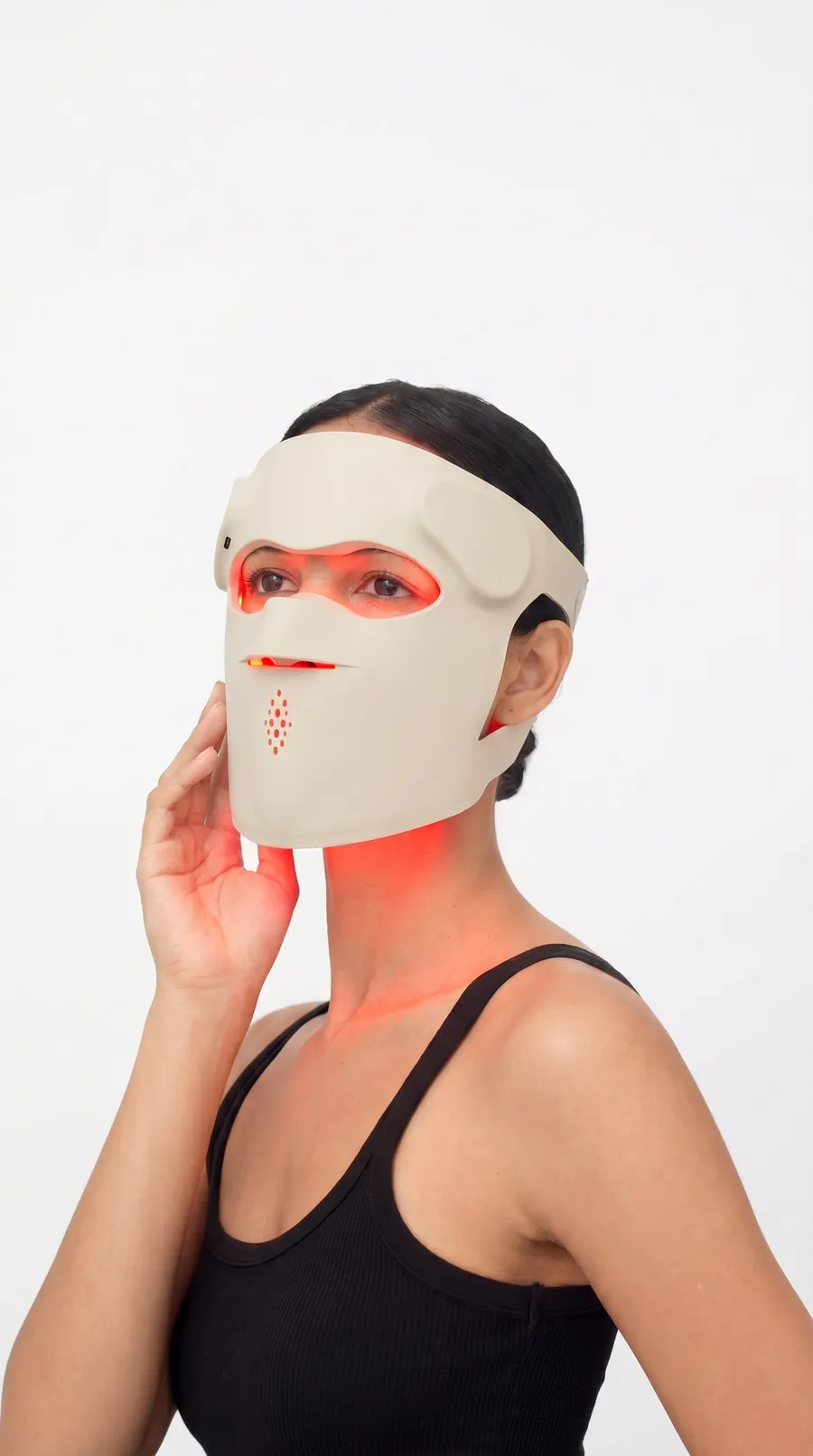
publish an irradiance figure. Without it, dose cannot be compared between masks.
Questions
On published specification, three come closest. The Omnilux Contour Face and the The Light Salon Boost Advanced both match its flexible-silicone build, its 633 nm red and 830 nm near-infrared pairing and its 10-minute session; the Boost also publishes a per-session dose and a searchable 510(k) number. The Dr. Renú SpectraLift Advanced matches the silicone build and the red/near-infrared pairing, adds blue and green, and carries more diodes.
What none of them has is CurrentBody’s third wavelength, deep near-infrared at 1072 nm — the wavelength with the thinnest independent literature of the three it uses. The rigid and semi-rigid masks here (Shark, Therabody, Dr. Dennis Gross) are a different proposition: they fit differently, and two of them need mains power.
The two share more than they differ on: both are full-face flexible silicone, both run a roughly ten-minute session, and both are FDA cleared and CE marked. On the published numbers the SpectraLift carries more diodes (280 to 236), a wider spectrum (four wavelengths to three, adding 465 nm blue and 530 nm green), a higher stated output (up to 50 mW/cm² against about 30), nine selectable modes rather than one automatic programme, and a searchable clearance number, K253712.
What the CurrentBody has and the SpectraLift does not is a third infrared wavelength at 1072 nm. Worth knowing in both directions: 1072 nm has the thinnest independent literature of the three CurrentBody uses, and the SpectraLift’s extra blue sits at 465 nm rather than the 415 nm most acne research uses, so neither brand’s extra colour is the reason to choose it. CurrentBody also has far wider retail distribution across the UK and EU, which matters for returns and support.
Both brands’ efficacy testing is run by the brand itself, as it is for almost every mask in this table.
Red at roughly 630–660 nm and near-infrared at roughly 830–850 nm carry the strongest published evidence for collagen, tone and texture. Blue around 415 nm is the wavelength used in most acne research.
Everything else — green, yellow, deep near-infrared at 1072 nm, and blue at 463–465 nm rather than 415 nm — has thinner support. Extra colours are not a bad thing, but they are not the reason a mask works. Seven of the nine masks in the table cover red and near-infrared; check that before counting colours.
Not on its own. Diode count mainly determines how evenly light reaches the whole face. What sets the dose is irradiance (mW/cm²) multiplied by session length.
That is why the irradiance column matters more than the LED column — and why it is mostly empty. Only four of the nine masks here publish an output figure at all, which makes true dose comparison across the category impossible. Treat LED count as a coverage number, not an efficacy number.
These masks are cleared, not approved. Clearance under section 510(k) means the manufacturer showed the device is substantially equivalent to one already on the market, and met safety and electrical standards. Approval is a much higher bar involving clinical trials, and applies to high-risk devices.
So clearance is a genuine safety and manufacturing signal. It is not evidence the device will work on your skin. Any brand advertising an LED mask as “FDA approved” is misdescribing it.
Two in this table print a specific 510(k) number you can search on the FDA database: The Light Salon Boost Advanced (K191629) and the Dr. Renú SpectraLift Advanced (K253712). The rest state that they are cleared without printing the number.
The Silk’n LED Face Mask 100 is CE marked as a cosmetic device and has no FDA clearance for that model — a meaningful difference from the others, not a small one.
If acne is your main reason for buying, look for 415 nm specifically — that is the wavelength most clinical work uses. In this table the Shark CryoGlow, Therabody TheraFace Mask Glo and Dr. Dennis Gross FaceWare Pro all use 415 nm.
Masks offering blue at 463–465 nm (Silk’n, Dr. Renú) sit off that peak, so treat their blue as a bonus rather than an acne treatment.
Where brands state a frequency they converge on three to five sessions a week; session length runs from 3 to 20 minutes depending on the device. Several publish only the session length and leave frequency to the manual. Longer or more frequent sessions are not documented to work better.
Consistency matters more than the specification. The mask you will actually wear several times a week beats the one with the better numbers.
Head to head
A category-wide graph of comparisons among all nine masks, using the same manufacturer-published fields. Dr. Renú remains highly visible, but it is not the mandatory counterpart.
Also compared
The same treatment, applied to the scalp side of the category: nine hair-growth light-therapy devices from iRestore, Theradome, Capillus, Kiierr, HairMax, illumiflow, CurrentBody and Dr. Renú — laser caps, LED caps and helmets, on manufacturer-published figures only.